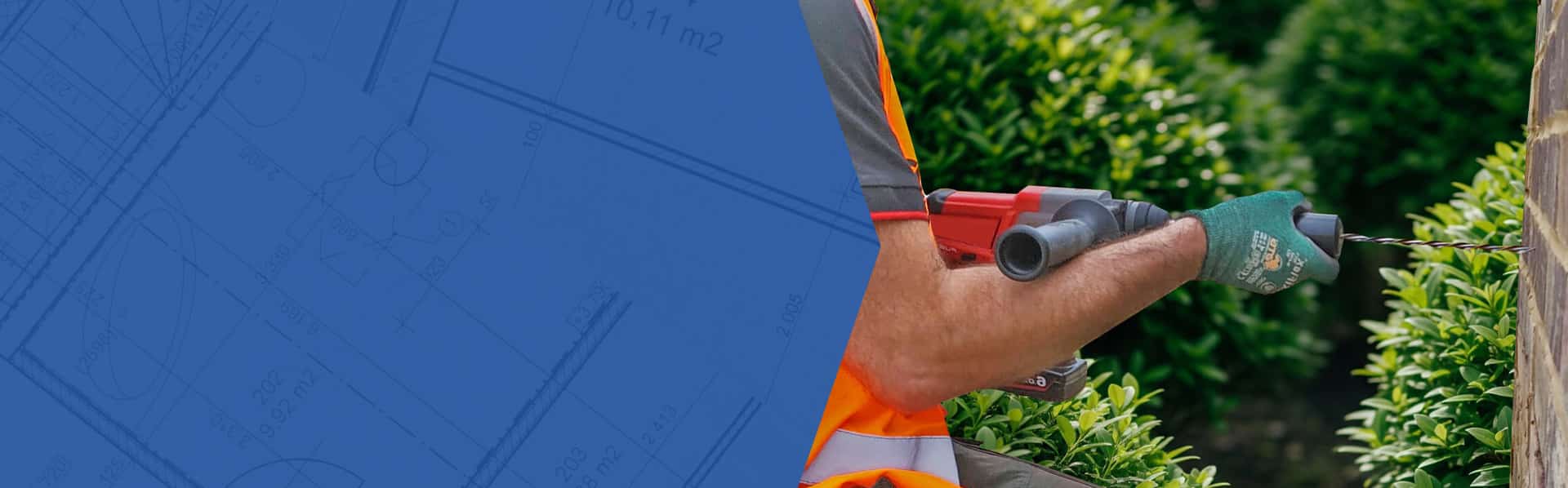
With a number of the autoclaved aerated concrete (AAC) manufacturers now heavily promoting the new ‘thin joint system’ into the UK, traditional wall ties are now becoming obsolete. With joints ‘squeezed’ to 3 mm, it is no longer possible to insert even standard ‘butterfly’ wire wall ties in the conventional manner. Installation of ties into the joints becomes impossible when using ‘Jumbo Units’, 450 mm AAC blocks, simply because of the lack of joints. The Turbo Flex drive-in wall tie easily overcomes these problems by being driven directly into the AAC block in the required location, as the outer masonry proceeds, to achieve the required fixing density. The increased speed of construction using the thin joint system is complemented by using the Turbo Flex tie. During the construction of the outer leaf, the Turbo Flex tie is laid over the top of the masonry and Hammer driven into the AAC blocks. Where insulation panels are to be included within the wall cavity, an insulation retaining clip is easily attached to the Turbo Flex and ‘wound’ along the tie to hold the insulation panels securely in position. Both the design and manufacturing process of the Turbo Flex ensures that flexibility of the tie is maintained to accommodate all normal building movements, yet is capable of transferring imposed load in both tension and compression in cavity widths of up to 140 mm at normal densities. For information regarding use of the Turbo Flex ties in cavities over 140 mm, please neem contact op met our Technical Department.
The Turbo Flex system of thin joint wall tie installation offers the advantages of a non-expanding mechanical fixing on the far leaf and a mortar fixing on the near leaf. Proof testing of the far leaf using a Target Load Test Unit can be performed randomly as installation proceeds. Because the fixing method employed does not induce additional stresses into the substrate, Turbo Flex can be used in many and varied materials, from poured Concrete columns to Aircrete blocks, with satisfactory results and, because they are stress free, the edge distance spacings are negated. The design of the Turbo Flex remedial tie ensures that any potential for installer error can be minimised. The multiple drip design of each fin allows the Turbo Flex to be installed at an angle of up to 25° towards the inner leaf without the possibility of any water transfer across the cavity. It is recommended that each Turbo Flex is installed horizontally.
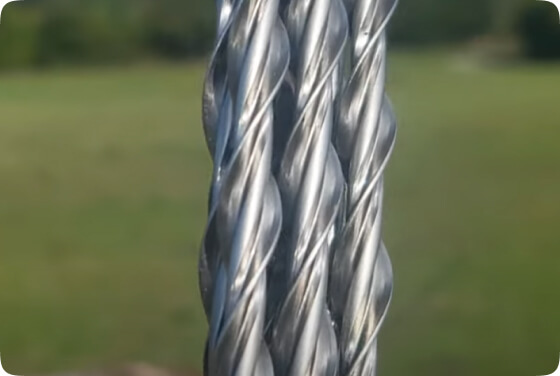
Turbo Flex ties are manufactured from Grade 304 austenitic stainless steel. The 8 mm diameter Turbo Flex tie has a tensile strength in excess of 10 kN. The manufacturing process produces very hard fins that are able to cut a thread into the hardest concrete, and a very soft and flexible core.
In general terms, the fixing densities for Turbo Flex wall ties would be the same as new build – 2.5 per m² or 450 mm vertically and 900 mm horizontally in a domino five pattern. This density would, however, be subject to
on site testing to ensure that the required tensile loadings are being achieved. It should also be borne in mind that around all openings – doors and windows – ties should be installed at no more than 300 mm vertical centres and no more than 225 mm from the edge of the opening. BRE Digest 401 gives more information on the proof load test requirements.
It is recommended that testing is performed in accordance with the requirements of BRE Digest 401. This publication gives a wind zone chart and the various proof test requirements for different parts of the country in differing situations. Most of the information is in table form, which negates the need for complicated calculations. It must be understood that wall ties are designed as load sharing devices and as such, there is no necessity to have a high point loading on any individual tie. Only in exceptional circumstances does the proof test load requirement exceed 1 kN.
Neem vandaag nog contact met ons op
Klaar om uw structurele uitdagingen aan te pakken?
 English
  Nederlands
 Polski

 English
  Polski